
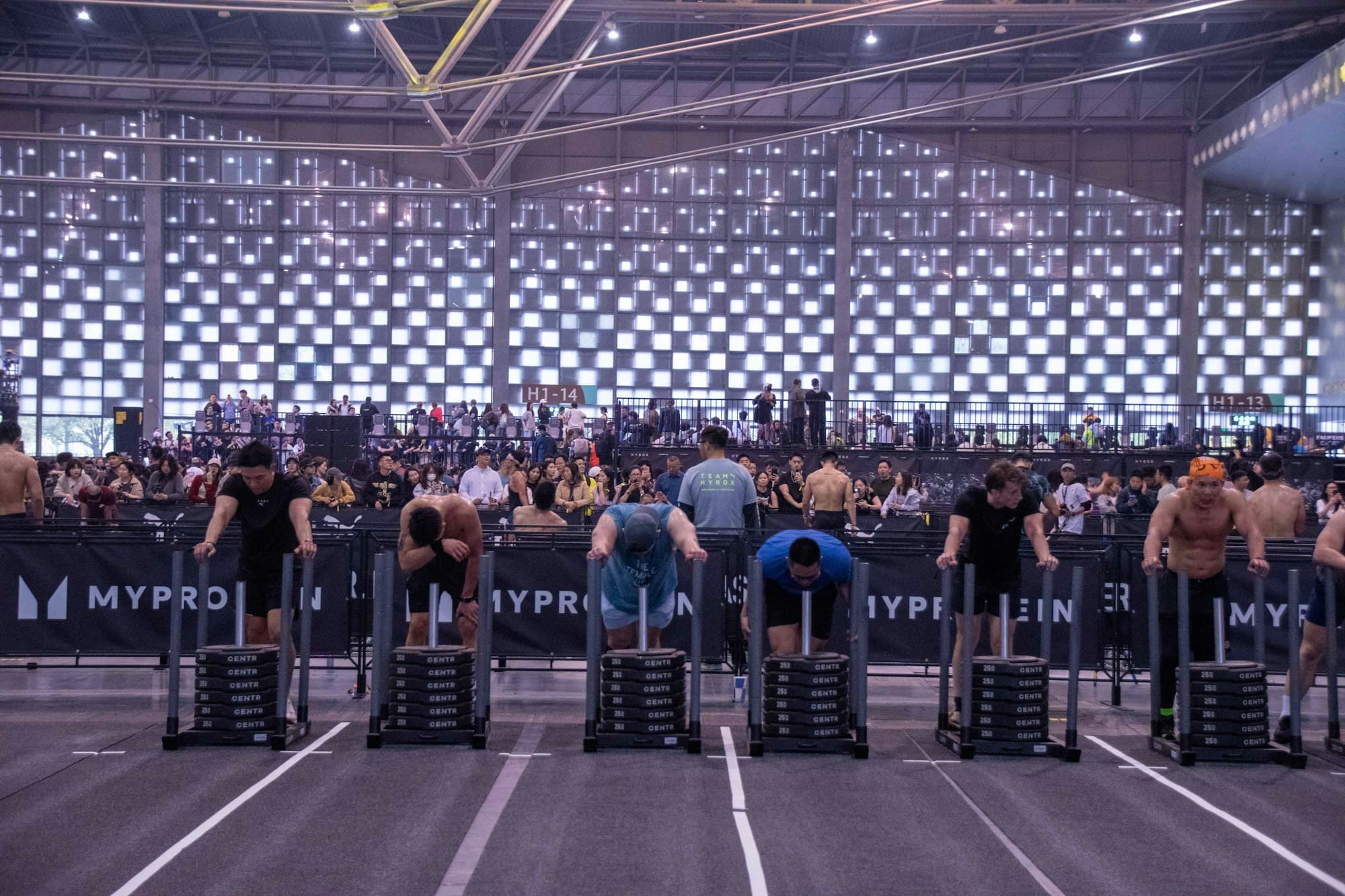
Creating a HYROX Simulation at Your Gym: From Idea to Race Day
25th April 2026
A HYROX simulation is one of the highest-leverage events a gym can put on. It builds community, attracts non-members, and gives existing athletes a target to train for. But the gap between "let's run a sim" and a smooth Saturday morning is usually wider than coaches expect. This guide walks through the design decisions you need to make before the doors open.
Decide What Kind of Simulation You're Running
The first call is whether you're mirroring a full HYROX race or designing something accessible. There's no wrong answer — it depends on your members.
- Full sim (1 km × 8 runs + 8 stations). Best for gyms with members already training for HYROX. Expect finish times of 60–110 minutes.
- Half-distance sim (e.g. 600 m runs). A great on-ramp for first-timers. Fort in London ran a 600 m version and saw very strong sign-ups from members who would never have entered a full distance.
- Time-capped stations. Tooting did this to keep heats moving when newer athletes hit the wall on sled push or burpees. Pick a cap (e.g. 4 minutes per station) and athletes move on regardless of completion.
Pick the format first — everything else (equipment, scaling, heat length) flows from this decision.
Audit Your Equipment
Walk the floor and confirm what you actually have for each station:
- Runs. Treadmills, an indoor loop, or a measured outdoor route?
- SkiErg + Rower. How many of each? This often becomes your bottleneck for heat sizing.
- Sleds. Heaviest weight available? Do you have a strip with enough length for 25 m?
- Burpee broad jumps. Mark a clear 80 m lane with cones or tape.
- Kettlebells / farmer's handles. Pairs at the right weights for each division.
- Sandbags. One per athlete, plus a few spares.
- Wall ball targets. Mixed-height target options for women, men, and scaled.
The number of SkiErgs and rowers usually dictates your heat size. If you have two of each, you can run heats of 4 (with two athletes per machine staggered) or heats of 8 if you're willing to run longer.
Choose Your Divisions and Weights
The official HYROX standards are:
Men's Pro
- Sled Push: 202 kg
- Sled Pull: 153 kg
- Farmer's Carry: 32 kg
- Sandbag Lunges: 30 kg
- Wall Balls: 9 kg
Men, Men's Doubles, Women's Pro, Doubles Mixed
- Sled Push: 152 kg
- Sled Pull: 103 kg
- Farmer's Carry: 24 kg
- Sandbag Lunges: 20 kg
- Wall Balls: 6 kg
Women & Women's Doubles
- Sled Push: 102 kg
- Sled Pull: 78 kg
- Farmer's Carry: 16 kg
- Sandbag Lunges: 10 kg
- Wall Balls: 4 kg
For a gym sim, most organizers scale these down. A rough rule of thumb: if you'd hesitate to put a beginner under that sled, scale it. The point of a simulation is to let athletes test fitness before the real race — not to wash them out at station three.
Do the Heat Math
Work backwards from your venue window. A few examples:
- 12 athletes per heat × 6 heats = 72 athletes across roughly 4 hours
- Stagger heat starts based on expected finish times (90 min for a full sim, 50 min for a 600 m sim)
- Run lighter divisions first so sled weights only go up between heats — fewer plate changes saves enormous time
If you let athletes pick their heat at registration, you can pre-sort them: early slots for lighter weights, later slots for heavier divisions, no manual reshuffling.
Set Up Registration
This is where most gyms lose hours to spreadsheets. The minimum you need:
- Ticket types per division (Open, Pro, Doubles, etc.) at the right price points.
- Heat selection so athletes pick their slot at sign-up, not by emailing you.
- Waiver collection built into checkout — not a separate Google Form.
- Payments going to the gym's bank account, not Eventbrite holding funds for two weeks.
- A public event page athletes can share on Instagram.
Fitlo handles all of this — you create the event, configure ticket types and heats, and the link goes live with payments routed via Stripe directly to your gym.
Price It
A simulation is one of the few competitions a gym can run profitably. Rough framework:
- £30–£50 / $40–$65 per individual entry for a half or capped sim
- £40–£65 / $50–$85 for a full sim
- Doubles: 1.6× the individual price (you sell two seats per pair)
- Add an early-bird tier that closes 3 weeks out to drive momentum
- Bundle a t-shirt, post-event drink, or photographer for ~£10 extra to lift average ticket value
If you have 60 athletes at £45, that's £2,700 — very healthy for a half-day event running on equipment you already own.
Recruit Volunteers
You need 1 volunteer per active station, plus 1–2 floaters and someone running the timer. A simulation with 2 stations active simultaneously realistically needs 4–5 helpers. Members usually volunteer eagerly in exchange for a free entry to the next sim.
The station that needs the most disciplined judging is wall balls — make sure athletes hit depth and the target consistently. Sled push/pull is largely self-policing.
Run the Day
Once you've made the design decisions above, race day becomes execution:
- Open doors 60 minutes before the first heat for check-in and warm-up.
- Use a participants page to tick athletes off as they arrive — anyone unaccounted-for at the 30-minute mark gets a phone call.
- Start each heat on a single timer; capture individual finish times as athletes cross the line.
- Post a rolling leaderboard so finished heats can see where they stand.
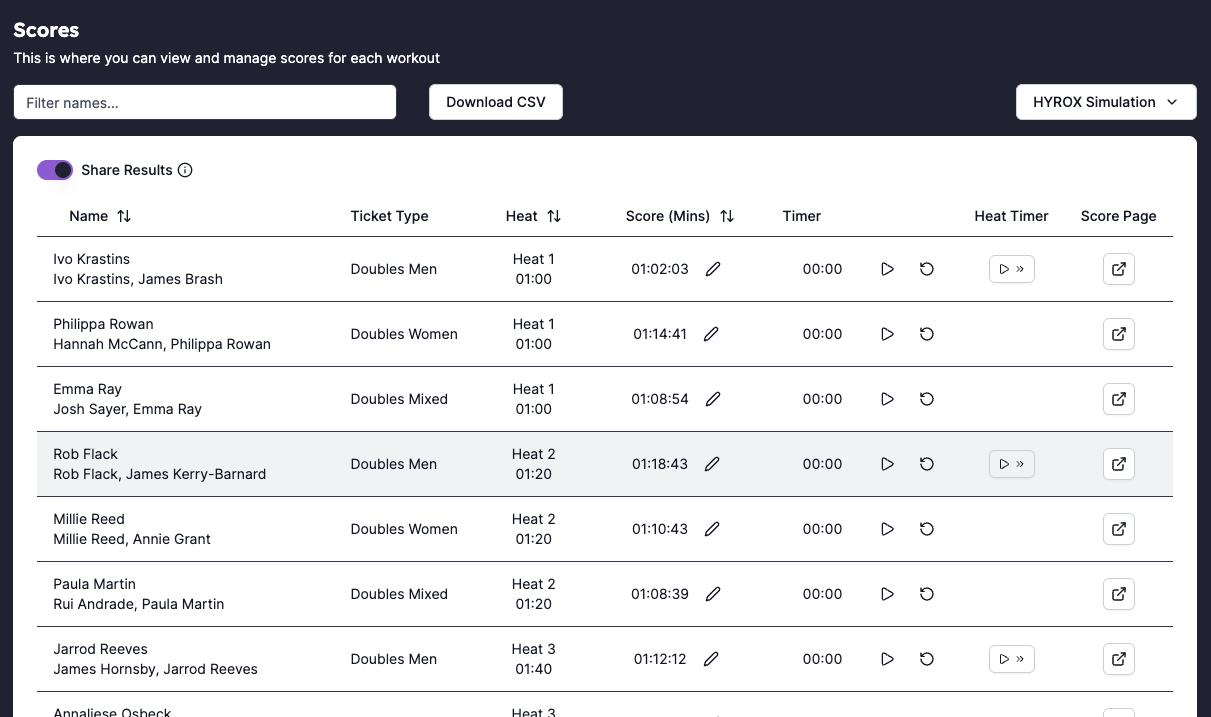
Fitlo's heat timer is built for this — one timer per heat, individual finish capture per athlete, results live on the leaderboard the moment you stop the clock.
Send Athletes Home With Something to Share
The post-event experience is what turns a one-off sim into a recurring fixture on your gym's calendar. Each athlete should walk away with:
- Their full station-by-station breakdown
- A shareable score page (great for an Instagram story)
- A discount code for the next event — momentum compounds when you announce dates 1
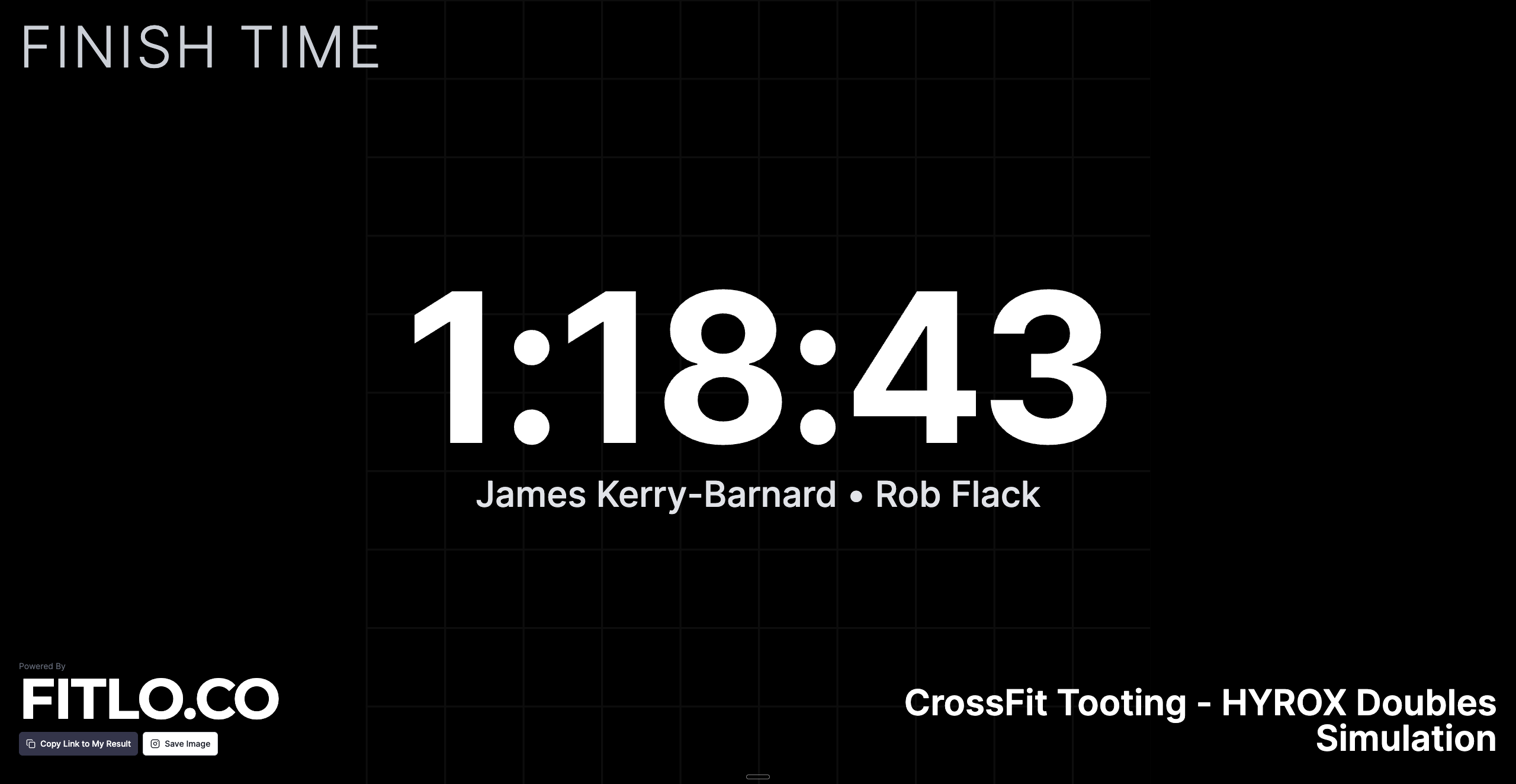
Fitlo emails a personalized score page to every athlete automatically after the event. It's free organic marketing — every share is a tagged post showing your gym ran a sold-out competition.
Start Planning the Next One
The data backs it up: athletes who participate in gym competitions are roughly 40% less likely to churn. The first sim is the hardest — you're learning the heat math, the equipment flow, and the communication cadence. The second one is easier. By the third, you have a repeatable playbook.
If you'd like a hand designing your first simulation, book a call and we'll walk through the format, heats, and registration setup with you.